


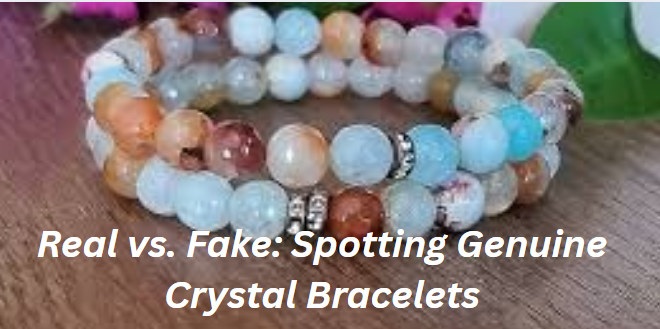
We have all been there. You are scrolling through Instagram or wandering through a bustling local market, and you spot them: gorgeous, glistening strands of beads promising to align your chakras and bring peace to your chaotic Tuesday. You buy one, maybe three. But when they arrive, something feels… off. They feel a little too light, or they look a little too perfect.
The market for crystal bracelets has exploded in recent years. Everyone from high-fashion icons to your neighbor who does yoga is wearing them. But with popularity comes the inevitable flood of counterfeits. As a crystal enthusiast who has spent way too much time and money curating a collection, I have learned the hard way that not everything that glitters is a gemstone.
It is frustrating, isn’t it? You are buying these pieces not just for their aesthetic beauty, but often for their healing properties and vibrational energy. If you are wearing a piece of dyed glass thinking it is Amethyst, the only thing you are manifesting is a lighter wallet.
In this guide, I am going to walk you through exactly how to play detective with your jewelry. We will look at the temperature, the weight, the visual cues, and the common imposters hiding in plain sight.
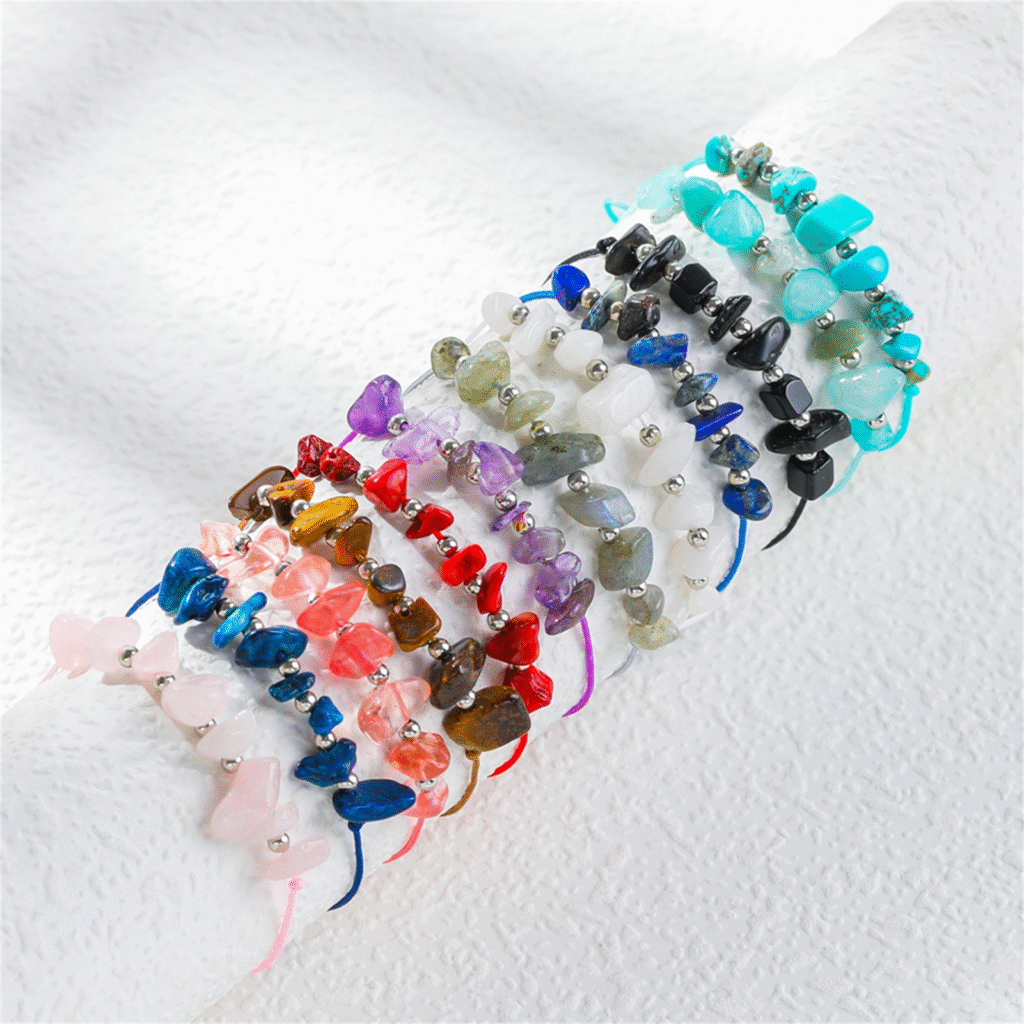
Why Authenticity Actually Matters
You might be thinking, “If it looks pretty, who cares?” And sure, if you are strictly buying for fashion, a plastic bead might serve you just fine. However, most people drawn to crystal bracelets are looking for a connection to the earth.
Crystals are formed under immense pressure and heat over thousands, sometimes millions, of years. That geological history is what gives them their specific energetic frequency. Natural stones like Quartz, Jasper, or Obsidian have a molecular structure that interacts with our own electromagnetic fields.
Glass, resin, and plastic do not have this history. They are inert. So, when you are trying to use a bracelet for grounding or anxiety relief, a fake simply acts as a placebo at best. Moreover, there is an ethical component. Natural mining is one thing, but mass-produced synthetic factories pumping out “fake” nature often cut corners on labor and environmental standards differently than artisanal miners do.
The Big Three Imposters: Glass, Plastic, and Resin
Before we get into the specific tests, you need to know the enemy. Most fake crystal bracelets fall into three categories.
Plastic and Resin: These are the cheapest fakes. They are lightweight, warm to the touch, and often have mold lines where the machine stamped them out.
Glass: This is the trickiest one. Glass can be heavy and cold, mimicking stone quite well. “Cherry Quartz” and “Opalite” are famous examples of glass sold as crystals. They are pretty, but they are man-made.
Reconstituted or Dyed Stone: This is where it gets murky. Sometimes, manufacturers take dust from real stones, mix it with glue (resin), and press it into beads. Is it real? technically, it contains stone DNA, but it lacks the structural integrity of the natural formation.
The Touch Test: Temperature Tells All
If you only remember one thing from this article, make it this: Real crystals are cold.
Nature is a fantastic conductor of heat. When you pick up genuine crystal bracelets, they should feel cool against your skin, even if they have been sitting in a warm room (unless they were in direct sunlight).
Here is a simple experiment you can do right now. Take your bracelet and touch it to your cheek or the inside of your wrist.
- Real Stone: It will feel instantly cold and will take a moment to warm up to your body temperature.
- Glass: It might feel cool initially but warms up very quickly.
- Plastic/Acrylic: It will feel room temperature or warm immediately. It acts as an insulator, not a conductor.
I always use the “cheek test” at flea markets. It looks a little funny to the vendors, but it is the fastest way to filter out the obvious plastic junk.
Visual Inspection: Perfection is Suspicious
We are conditioned to look for perfection in products. We want flawless screens on our phones and unblemished fruit at the grocery store. But when it comes to geology, perfection is a red flag.
Real gemstones are created by nature, and nature is messy.
1. Look for Inclusions
Hold your bracelet up to a light source. If you are looking at transparent stones like Amethyst, Rose Quartz, or Citrine, you should see internal fractures, cloudy spots, or tiny specks. These are called inclusions. They are the fingerprints of the stone.
If the bead is perfectly clear, like a windowpane, it is likely glass. If it is perfectly uniform in color without any variation, it might be plastic or dyed.
2. The Bubble Trouble
This is a dead giveaway. Real stones do not have air bubbles. They are formed under high pressure. Glass, however, is blown or molded, and tiny air bubbles often get trapped inside.
Get a magnifying glass (or just use the zoom on your phone camera). If you see a tiny, perfectly round bubble suspended inside the bead, you are looking at glass, not a gemstone.
The Hardness Factor: The Mohs Scale
Geologists use the Mohs Hardness Scale to determine the durability of a mineral. Talc is a 1, and Diamond is a 10. Most stones used in crystal bracelets fall somewhere between a 6 and a 7 (like Quartz and Agate).
Glass usually sits around a 5.5. Plastic is much lower, around a 2 or 3.
While I don’t recommend scratching your beautiful new bracelet with a steak knife, you can do a subtle scratch test if you are unsure.
- The Test: Try to scratch the bead with a steel pin or needle.
- The Result: If the pin leaves a deep scratch easily, it is likely plastic or a very soft stone (like Selenite or Calcite, which are rare for bracelets due to their softness). If the pin slides off without leaving a mark, it is likely harder than steel, pointing towards genuine Quartz or Agate.
Common Fakes You See Everywhere
Some stones are faked more than others because they are rare or expensive. Here is a breakdown of the usual suspects I see sold as genuine crystal bracelets.
Malachite
Real Malachite is heavy, cold, and has complex, swirling patterns in various shades of green.
- The Fake: Synthetic Malachite is made of clay or plastic. The pattern is too contrasting—usually stark black lines against bright green. It looks like it was painted on.
Turquoise
This is arguably the most faked stone in history. Genuine Turquoise is expensive and relatively soft.
- The Fake: Most “Turquoise” on the market is actually a white stone called Howlite that has been dyed blue. Look at the cracks (the matrix). If the dye has pooled in the cracks, making them darker blue, it is a dye job.
Citrine
This one breaks my heart because real Citrine is stunning.
- The Fake: Most commercial “Citrine” is actually Amethyst that has been baked in an oven until it turns orange. If the bracelet is a burnt, bright orange or reddish hue, it is heat-treated Amethyst. Real Citrine is a pale, champagne yellow or smoky color.
Lapis Lazuli
Real Lapis is a deep celestial blue often flecked with gold Pyrite.
- The Fake: Fakes are often just grey stones dyed blue. Use a cotton swab with a little acetone or nail polish remover. Rub it on an inconspicuous bead. If the blue comes off on the cotton, it’s dyed.
Comparison Guide: Real vs. Fake Features
To make this easier to digest, here is a quick reference table you can use when you are shopping.
| Feature | Genuine Crystal Bracelets | Fake (Glass/Plastic/Resin) |
| Temperature | Cold to the touch; warms slowly | Warm or room temp; warms fast |
| Weight | Has a satisfying heft/weight | Feels unusually light (plastic) |
| Appearance | Imperfect; inclusions; color variation | Flawless; uniform color; air bubbles |
| Pattern | Random, chaotic, organic | Symmetrical, repetitive, painted-on |
| Price | Varies; rare stones cost more | Uniformly cheap regardless of stone |
| Drill Holes | Rough edges are common | perfectly smooth or white residue |
The “Trade Name” Trap
Marketing is a powerful tool, and the gem trade is full of fancy names for man-made glass. If you see crystal bracelets labeled with these names, know that they are not natural stones from the earth.
- Opalite: Milky, iridescent glass. It glows blue/orange. It is pretty, but it is glass.
- Goldstone: Brown or blue with glitter inside. This is glass made with copper flecks. It was supposedly invented by accident by Italian monks (a cool story, but still glass).
- Cherry Quartz: Smelting quartz or glass with pink dye swirls.
- Aqua Aura: This is real quartz that has been bonded with gold vapors. So, the base is real, but the color is human-engineered.
There is nothing wrong with owning these! I have a Goldstone piece that I adore. But it is important to know what you are buying so you don’t overpay or expect natural energetic properties.
How to Shop Safely Online
Buying online is terrifying because you can’t do the touch test. However, you can still protect yourself.
1. Read the Reviews (The Right Way)
Don’t just look at the star rating. Read the comments. Look for people complaining about dye rubbing off on their wrists. Look for photos posted by users—often the user photos look very different from the professional product shots.
2. Check the Price
If you see a seller offering a “Genuine Moldavite Bracelet” for $15, run away. Moldavite is incredibly rare and expensive. If the price seems too good to be true, it almost certainly is. Authentic crystal bracelets made of semi-precious stones generally start around $20-$40 depending on the stone quality, and go up from there.
3. Look for “Natural” vs. “Synthetic” in the Description
Honest sellers will list the material. If they use words like “simulant,” “lab-created,” or “man-made,” they are telling you it is not natural. If the description is vague and just says “gemstone style,” be wary.
A Note on “Aura” and Treated Stones
You will often see crystal bracelets that look like they have been dipped in a rainbow oil slick. These are usually “Aura” Quartz.
This is a controversial topic in the crystal community. These are real natural quartz crystals that have been bonded with metals (like titanium or platinum) in a vacuum chamber.
- Are they real? The base stone is real. The coating is man-made.
- Do they have energy? Many people believe the combination of the quartz and the precious metal creates a unique, high vibration.
- Verdict: They aren’t “fake” in the sense of being plastic, but they are heavily processed. If you like the look, go for it!
Trust Your Gut Intuition
Finally, you have to trust your intuition. You are buying these items to connect with your higher self, right? So use that sense.
When you hold the bracelet, how does it make you feel? Does it feel “dead” or plastic? Or does it have a certain weight and presence? I have walked away from stunning-looking pieces because they just felt… empty. And I have dug through bargain bins to find ugly little rocks that felt like they were vibrating in my hand.
Conclusion
Building a collection of crystal bracelets is a journey. You are going to make mistakes. I have bought my fair share of dyed agate thinking it was high-grade carnelian. It happens to the best of us.
But now you have the toolkit to make smarter choices. You know how to check the temperature, look for those tell-tale bubbles, and spot a suspicious price tag a mile away. Remember, real crystals are perfectly imperfect. They carry the history of the earth inside them.
Next time you are browsing a shop, take a second to really look at what you are buying. Your wallet will thank you, and your energy field will too.I would love to hear from you. Have you ever bought a bracelet only to realize later it was a fake? Or do you have a specific test you swear by? Drop a comment below and share your story—let’s help each other avoid the scams!
FOR MORE: https://britsphere.co.uk/